20 Ways The Friday Institute Changed K-12 Education
While our initiatives have changed over the years to meet the needs of educators and students, our mission and vision have remained the same: advance K-12 education through innovation in teaching, learning and leadership so that all learners are prepared to succeed in a rapidly changing world. See how we've stayed true to that mission over the last 20 years.
Our innovative professional development programs reached a record number of educators.

From hosting the last year of our popular LASER Institute to launching InSTEP, an innovative online space to support teachers’ professional learning, the Friday Institute has engaged educators in a number of professional development opportunities. For example, our computer science (CS) team trained the most new Code.org teachers in grades 6-12.
400
educators in grades 6-12 were trained by the Friday Institute computer science team in the last three years
10%
of all teachers who participated in Code.org’s CS professional learning programs in 2023 and 2024
were trained by the Friday Institute
27K
students impacted in the last three years by the Friday Institute’s computer science training
Our work informed the state’s connectivity initiatives–including internet access and connectivity for all North Carolinians.
For students to access the innovative curriculum and practices we support, infrastructure needs to be in place. Our work has informed North Carolina’s Digital Opportunity Plan, K-12 cybersecurity and school connectivity initiatives in order to support the development of technology infrastructure for digital learning.
Three ways we support digital learning

Friday Institute Team to Support Next Phase of the North Carolina Digital Opportunity Plan in New NCDIT-Funded Project
Read more

North Carolina School Connectivity Initiative
Read more

NCDPI, Friday Institute, MCNC Highlight Scope of No-Cost Cybersecurity Resources and Services for the First Time During NCDPI K-12 Cybersecurity Bootcamp
Read more
We helped every single student and teacher in all 115 school districts in North Carolina gain access to unlimited broadband in their classrooms.
North Carolina was the first state in the country to offer unlimited broadband to all students.
We increased exposure to STEM for middle and high school students through our Math Science Education Network (MSEN) program.
99%
of MSEN graduating seniors we’ve served matriculate to four-year colleges
70%
of graduating seniors we’ve served major in STEM or education careers
100
middle and high school students participate in the MSEN program each year
Three Ways We supported educators during the COVID-19 pandemic



We supported the research, practice and policy issues around AI integration in K-12 schools.

The Friday Institute is focused on innovation and technologies that are transforming education. Artificial intelligence (AI) is changing the landscape of K-12 education in every district, school and classroom. At the Friday Institute, we are working with educators and educational leaders to leverage AI for deeper learning, support teachers and students in effective uses of AI, build capacity for teachers and education leaders and conduct research on AI integration in instruction.
We worked to reduce the homework gap in North Carolina.

We led foundational research and conducted systematic evaluations that will improve innovative approaches to teaching and learning.

For example, a collaborative team from the Friday Institute for Educational Innovation and the NC State College of Education assessed the impact of the teacher compensation models and advanced teaching roles (ATR) program on teaching and learning in North Carolina. In addition, this evaluation included a comparative analysis of program implementation in order to help identify and scale the most effective components of these programs.
We are connecting students and educators around the world.
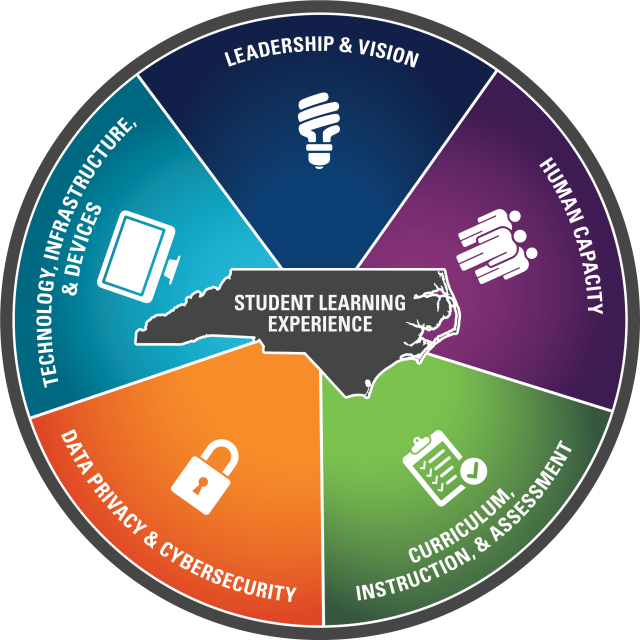
We developed the NC Digital Learning Plan for K-12 Education
We are leaders in North Carolina and the nation in supporting educators for teaching statistics and data science in K-12 education.


- Data Science Summer Institute Equips Educators with Practical Incorporating Data Science Into Their Classrooms
- Mathematics Teacher Educators and Experts Gather for National Summit on Transforming Mathematics Teacher Preparation in Data Science and Statistics
- Hollylynne Lee and Gemma Mojica Host Online Workshop for Teachers As New Co-Chairs for the American Statistical Association’s Meeting Within a Meeting
In partnership with NC State College of Education researchers, we shaped pedagogical practices and learning outcomes across the state of North Carolina.
As part of the NC State College of Education, we engage in collaborative research with many expert researchers within the College that impacts teaching and learning across the state. Since 2018, the Friday Institute and the College of Education has provided funding for more than 20 research projects through Catalyst Grants to support collaborative research projects between faculty and staff and aid research that could lead to further inquiry and support.
We forged a path in online professional learning for educators.

We’re empowering students to tackle global and local problems in their communities.
We were key in securing $400 million for education reforms in North Carolina.
The ultimate goal of North Carolina’s Race to the Top plan was to build statewide capacity that could support sustained, long-term improvements in public education; namely, increases in student achievement, reductions in achievement gaps and increases in graduation rates.
We equip education researchers and practitioners with the knowledge, skills and resources necessary to effectively leverage digital data sources and data science methods.

Since 2020, the Learning Analytics in STEM Education Research (LASER) Institute has
empowered 183 early to mid-career researchers across 33 states and 5 countries to examine and improve STEM learning environments through leveraging learning analytics.The LASER Institute has made a lasting contribution to STEM education
research by developing scholars’ technical expertise, fostering collaboration and promoting actionable research. Its impact is evident in the breadth of academic productivity, the role LASER has played in broadening participation in STEM education and the meaningful change that has resulted, driven by LASER scholars’ application of their training. As a model for professional development in STEM education, LASER has demonstrated the importance of targeted capacity-building initiatives in shaping the future of learning analytics and educational research.
The LASER Institute has produced or facilitated:
183
LASER Scholars
80+
products
21
articles and books