Inquiry in Action: Exploring One Health Through Project Based Inquiry (PBI) Global
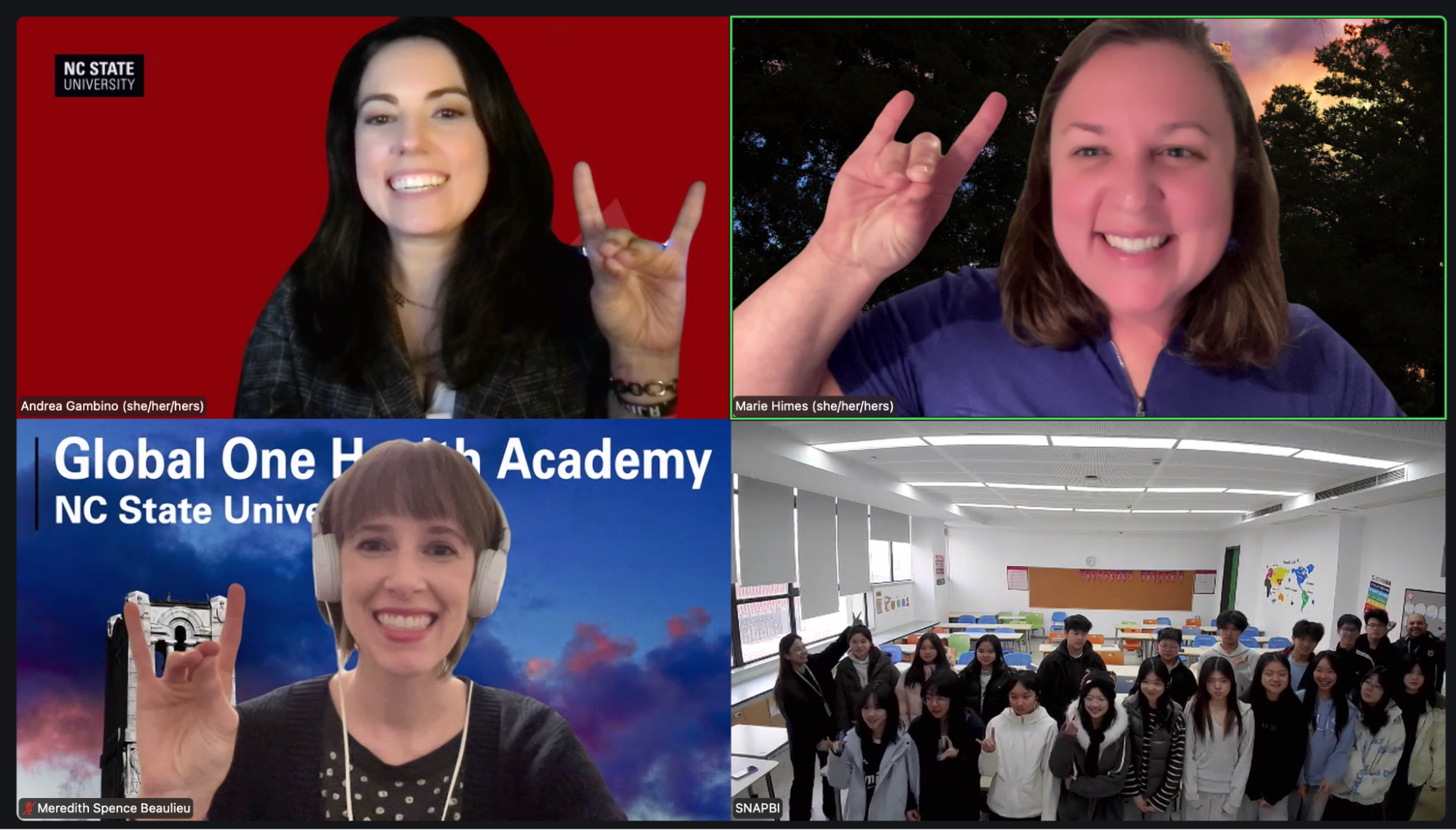
In Suzhou, China, a class of high school students from Suzhou North America High School (SNA) began their school day with great anticipation. They had spent weeks in small groups wrestling with United Nations Sustainable Development Goal (SDG) 3: Good Health and Well-Being. Their work took place through Project-Based Inquiry (PBI) Global, a 10+ year initiative facilitated by New Literacies Collaborative (NLC) Director Marie Himes and her team at the Friday Institute for Educational Innovation.
PBI Global, developed by Hiller Spires, NLC founder and former director, cultivates students’ agency toward solving complex, enduring glocal (global + local) challenges. That morning, the students chose curiosity over convenience and opened Zoom with energy and purpose, ready to push beyond textbooks. They wanted to see how their questions lived in the real world—and whether ideas could turn into action.
Their conversation centered on One Health, a framework that treats human, animal and environmental health as inseparable. Meredith Spence Beaulieu, university program manager of the Global One Health Academy (GOHA) at NC State University, brought this idea to life. As a medical and veterinary entomologist and leader at GOHA, she works at the intersection of science, policy and public engagement. Her career shows what happens when research leaves the lab and enters communities, systems and decision-making spaces.
Student questions drove the session forward. They asked how scientists measure the health impact of companion animals after COVID-19 and how that research could support animal adoption and service programs. They pressed on how governments can shape pharmaceutical innovation to improve access and affordability. They probed links between food safety rules and emerging diseases. These questions did more than check boxes. They challenged systems. They imagined change. Students shifted from learners to agents—using inquiry as a tool to connect knowledge, responsibility and impact.
The impact of the session extended beyond the call itself. Reflecting afterward, SNA teacher Simon Mysak captured why experiences like this matter:
I’m feeling extra appreciative of PBI Global as a way to get students thinking. If we can help students apprise themselves of the need for interdisciplinary studies before diving into their specializations, perhaps we will start to see a new generation of scholars who accelerate needed changes.
His words underscore the larger promise of inquiry-driven learning: when students engage real experts and real problems, they begin to see themselves not just as future specialists but as collaborators in shaping healthier, more sustainable and more connected communities and systems.
To learn more about PBI Global and connect with the Friday Institute’s New Literacies Collaborative, please reach out to Marie Himes at [email protected].
About the Author


