Educators Work to Advance CS in Elementary Education at Statewide Convening at the Friday Institute

Computer science may be thought of as an advanced subject, but elementary school teachers are already teaching computer science (CS) standards; they just don’t realize it. For example, beginning-of-the-day routines are algorithms. Teachers have given their students a set of step-by-step instructions designed to produce a desired output. Natalie Hulbert, elementary computer science education consultant at the North Carolina Department of Public Instruction (NCDPI) believes teachers shouldn’t see CS integration as something added to their plate but as a part of it.
“A teacher’s plate is overflowing as it is in the classroom,” said Hulbert. “So I want them to look at it as computer science being like mashed potatoes and the math that they’re already teaching is the hamburgers and gravy, and we’re just mixing it together on the plate. We’re not adding one more thing. We’re just kinda mixing it together so that they work well together.”
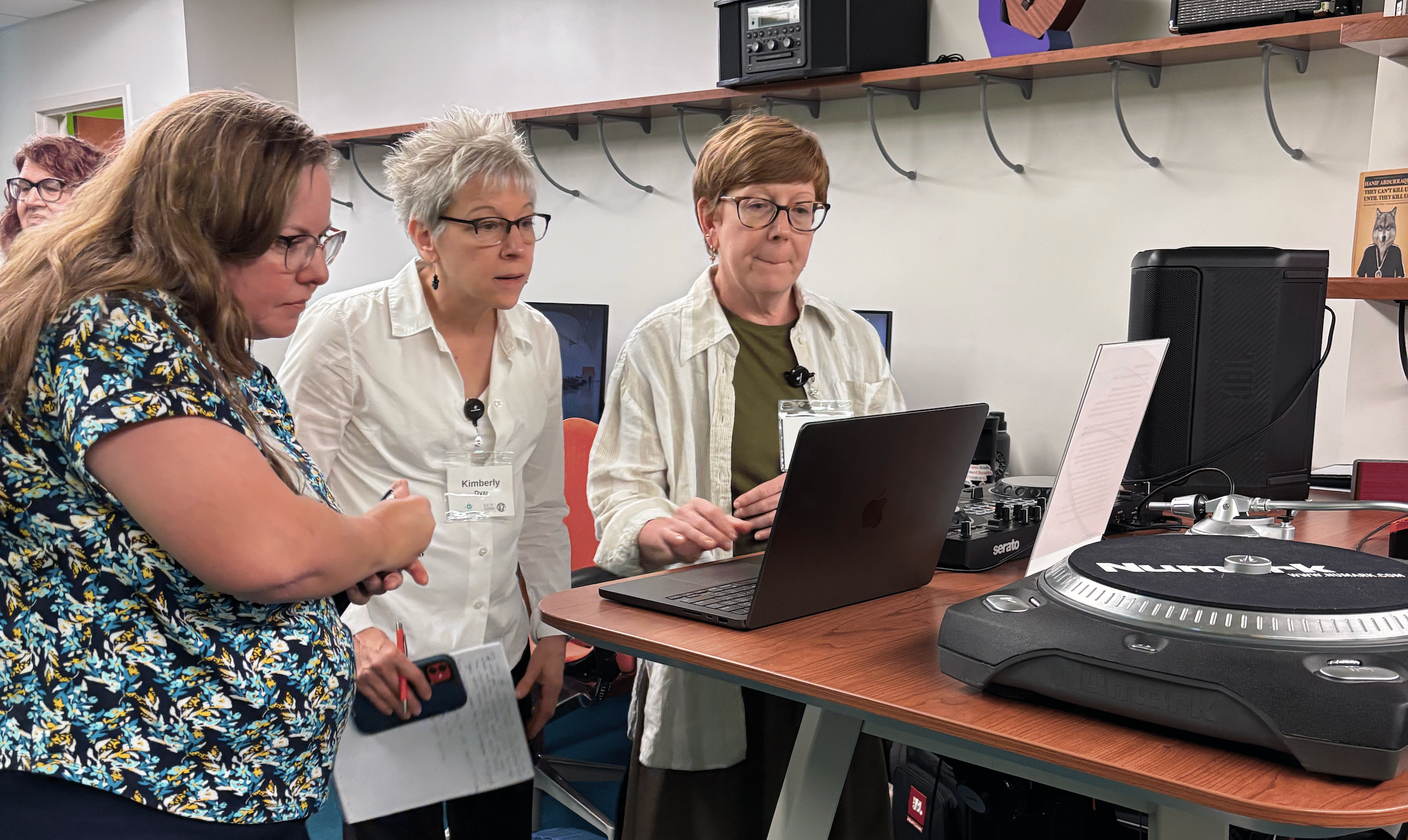
Educators from across the state discussed CS integration and opportunities for elementary educators at the Computer Science: It’s Definitely Elementary! convening at the Friday Institute for Educational Innovation Dec. 12. In partnership with the Computer Science, IT, and Technology Education office at NCDPI, a team at the Friday Institute aimed to advance CS in elementary education by promoting its access for all North Carolina students through building community with educators, districts and partners; addressing challenges and co-creating solutions that support teachers and students in CS integration; and identifying resources for integration.

Recent North Carolina initiatives in CS and artificial intelligence (AI), such as the implementation of K–12 Computer Science Standards with a computer science graduation requirement, show the state’s commitment to ensuring that all students have access to high-quality CS and AI learning. But the typical focus of programs are on middle and high school students.
The Computer Science: It’s Definitely Elementary! convening was a first step in making statewide elementary CS and AI educational initiatives more visible and accessible across the state.
“By connecting with each other, advocating for and supporting elementary teachers who are able to integrate computer science and AI in their instruction, we are broadening access to these advanced concepts for all students and improving their future job outlook,” said Rebekah Davis, principal investigator for the project and research scholar at the Friday Institute. “Career and technical education (CTE) instruction has traditionally focused on middle and high schools, but including the elementary level expands opportunity and should contribute to a more skilled workforce overall.”
The event’s keynote speaker Steve Johnson, director of summer engineering programs at NC State, emphasized the importance of saying yes to things, including CS and STEM integration, in order to understand how to address challenges and how certain ideas might lead to further innovation. He also discussed why STEM subjects aren’t just for “the smart kids.”

“Too many kids, unfortunately, they hear STEM, and they hear science and math, and they associate that with the smart kids being able to do it,” said Johnson. “But what I’ve found, in my experience, over and over again is the kids that do the best in STEM are the kids that are traditionally not that great on the test. They might not test well…but you put a building project in front of them, and they will be leaders in that classroom. And so, that’s the kind of mindset that I love to shift for teachers; let your kids try it and then see who surprises you, because it always happens.”
During the event, attendees participated in job-alike groups, an unconference and an activity to achieve educational excellence through CS in elementary school. They were able to connect their work in schools and districts to broader state strategies and resources from educational partners, and share ways that existing programs can better serve elementary teachers and students.
“I believe that conferences like this are so important because I’m talking to people who I honestly probably would have never met or thought to reach out to about things that can help me to be successful in my classroom,” said Kristin Calhoun-Minnis, a STEM educator at Butler Avenue Elementary.
During job-alike sessions, participants discussed reframing CS education as a fundamental literacy and essential skill for student success, embedding support into current school and classroom routines and identifying barriers for integration. Mixed-group sessions focused on integrating CS into existing curriculum and providing capacity for professional development for educators.
“If you are giving children a car to drive, we teach them,” said Ellie Ebrahimi, associate professor at the University of North Carolina at Wilmington. “We spend the time teaching them how to drive that car. When it comes to any skills, we need to train them. We need to educate them.”
Participants consistently discussed how CS is commonly considered an advanced subject for older students but that foundational vocabulary and procedural knowledge can be taught to younger children. Integrating CS and AI in the elementary classroom is possible despite barriers.

“Computer science is more than just computers,” said Hulbert. “It helps students prepare to be computational thinkers, thinking outside the box, problem solvers. Introducing students to computer science as early as pre-K helps teach them durable skills. Those are just important skills that kids need from the beginning, and they help prepare them for career-ready jobs as well.”
Ultimately CS can be integrated into all subjects in the elementary space if educators can embrace it.
“It works, our students enjoy it and it’s really fun to play with,” said Calhoun-Minnis. “Once you get kind of the grasp of it, and you can weave it into what’s already happening, as opposed to just stacking it on top, it becomes something that you can really utilize as a resource that adds to what you’re already doing. So, it’s honestly one of those, like, either you’re gonna get on board, or you’re truly gonna be left behind, and I don’t want any of my students to be left behind.”